

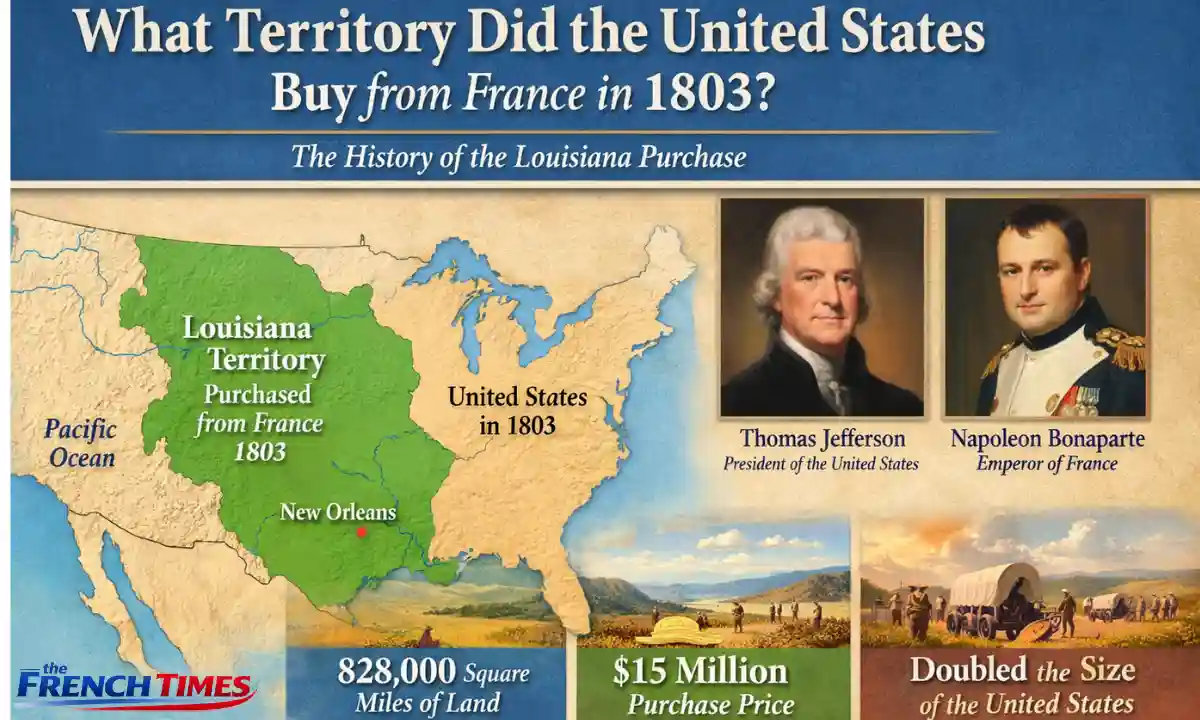

The question “What territory did the United States buy from France in 1803?” refers to a landmark event in global and American history the Louisiana Purchase. Concluded in 1803, this strategic acquisition fundamentally altered the trajectory of the United States by significantly expanding its territorial boundaries, strengthening its economic foundation, and reducing European influence in North America. The purchase of the Louisiana Territory from France stands as one of the most visionary and consequential decisions in U.S. history, shaping the nation’s development for generations.
What Territory Did the United States Buy from France in 1803?
In 1803, the United States acquired the Louisiana Territory from France. This vast expanse of land encompassed a significant portion of central North America, stretching from the Mississippi River in the east to the Rocky Mountains in the west, and from the Gulf of Mexico in the south to present-day Canada in the north. Rather than being a single administrative unit, the territory consisted of a diverse and expansive region that would later be divided into numerous U.S. states.
This acquisition granted the United States control over critical waterways, particularly the Mississippi River, which was essential for commerce, agriculture, and transportation. It also ensured the nation’s ability to expand westward without interference from rival European powers.
The Louisiana Purchase: Nature and Scope of the Agreement
The Louisiana Purchase was a formal agreement between the United States and France through which approximately 828,000 square miles (2.14 million square kilometers) of land were transferred to American ownership. This acquisition effectively doubled the size of the United States, making it one of the largest nations in the world at the time.
The agreement was finalized under the administration of President Thomas Jefferson, who recognized the immense strategic and economic advantages of acquiring such a vast territory. For France, the decision to sell was influenced by geopolitical challenges and financial constraints.
Historical Background of the Louisiana Territory
The Louisiana Territory had a complex colonial history prior to its acquisition by the United States. Initially claimed by France in the late 17th century, the territory was later ceded to Spain following the Seven Years’ War. In 1800, Spain secretly returned the territory to France under the Treaty of San Ildefonso.
This transfer raised concerns within the United States, as France under the leadership of Napoleon Bonaparte was a dominant European power. American leaders feared that French control over Louisiana could threaten U.S. trade interests, particularly access to the Mississippi River and the strategically vital port of New Orleans.
Strategic Motivations Behind the Purchase
1. Securing Trade Routes
Access to the Mississippi River and the port of New Orleans was essential for American farmers and merchants. Control over these routes ensured economic stability and growth.
2. Preventing European Encroachment
The presence of a powerful European nation in North America posed a potential threat. Acquiring the territory eliminated this risk and strengthened national security.
3. France’s Financial and Military Pressures
France was engaged in costly military campaigns in Europe and faced challenges in maintaining overseas territories. Selling Louisiana provided immediate financial relief.
4. Administrative Challenges
The sheer size and distance of the Louisiana Territory made it difficult for France to govern effectively, particularly in the absence of a strong military presence.
5. British Threat
France feared that Britain might seize the territory during ongoing conflicts. Transferring it to the United States was a strategic decision to prevent British expansion.
Key Figures and Their Roles
Thomas Jefferson
As the third President of the United States, Thomas Jefferson was instrumental in initiating and approving the purchase. Although he initially questioned the constitutional authority to acquire foreign land, he ultimately prioritized national interest and authorized the deal.
Napoleon Bonaparte
Napoleon Bonaparte, the French ruler, played a decisive role in offering the territory for sale. His focus on European affairs and the need for financial resources led him to abandon France’s ambitions in North America.
Financial Terms of the Agreement
The United States acquired the Louisiana Territory for $15 million, a sum that included both the purchase price and the settlement of existing debts owed by France to American citizens. This equates to approximately three cents per acre, making it one of the most advantageous land acquisitions in history.
Territorial Outcomes and State Formation
The Louisiana Purchase laid the foundation for the creation of multiple U.S. states. Entire states such as Louisiana, Missouri, Arkansas, Iowa, Nebraska, and Kansas emerged from this territory, while others including Montana, Wyoming, Colorado, Minnesota, and the Dakotas were partially formed from it.
This expansion provided vast opportunities for settlement, agriculture, and economic development, significantly contributing to the nation’s growth.
Impact on the United States
1. Territorial Expansion
The most immediate impact was the doubling of the nation’s size, which enhanced its geopolitical significance.
2. Economic Development
The newly acquired land offered fertile agricultural regions and access to vital trade routes, boosting economic productivity.
3. Westward Expansion
The purchase facilitated the movement of settlers into new territories, promoting exploration and development.
4. Reduction of European Influence
By removing France from North America, the United States minimized the influence of European powers in the region.
5. Scientific Exploration
The acquisition led to exploratory missions such as the Lewis and Clark Expedition, which provided valuable geographic and scientific insights.
Long-Term Significance
The Louisiana Purchase played a foundational role in shaping the identity and future of the United States. It supported the concept of continental expansion and contributed to the emergence of the nation as a major power. The acquisition also reinforced the idea that strategic diplomacy and negotiation could yield transformative results.
Conclusion
In summary, the territory that the United States purchased from France in 1803 was the Louisiana Territory. This historic acquisition was far more than a simple land transaction; it was a strategic milestone that redefined the nation’s boundaries, strengthened its economy, and secured its future. The Louisiana Purchase remains one of the most influential decisions in American history, demonstrating the power of foresight, diplomacy, and national vision.
FAQs
What territory did the United States buy from France in 1803?
The United States purchased the Louisiana Territory.
How large was the Louisiana Territory?
It covered approximately 828,000 square miles.
How much did the United States pay for the Louisiana Purchase?
The total cost was $15 million.
Who were the key figures involved in the deal?
Thomas Jefferson represented the United States, while Napoleon Bonaparte represented France.
Why is the Louisiana Purchase historically significant?
It doubled the size of the United States and enabled westward expansion, shaping the nation’s future development.

